
Share this
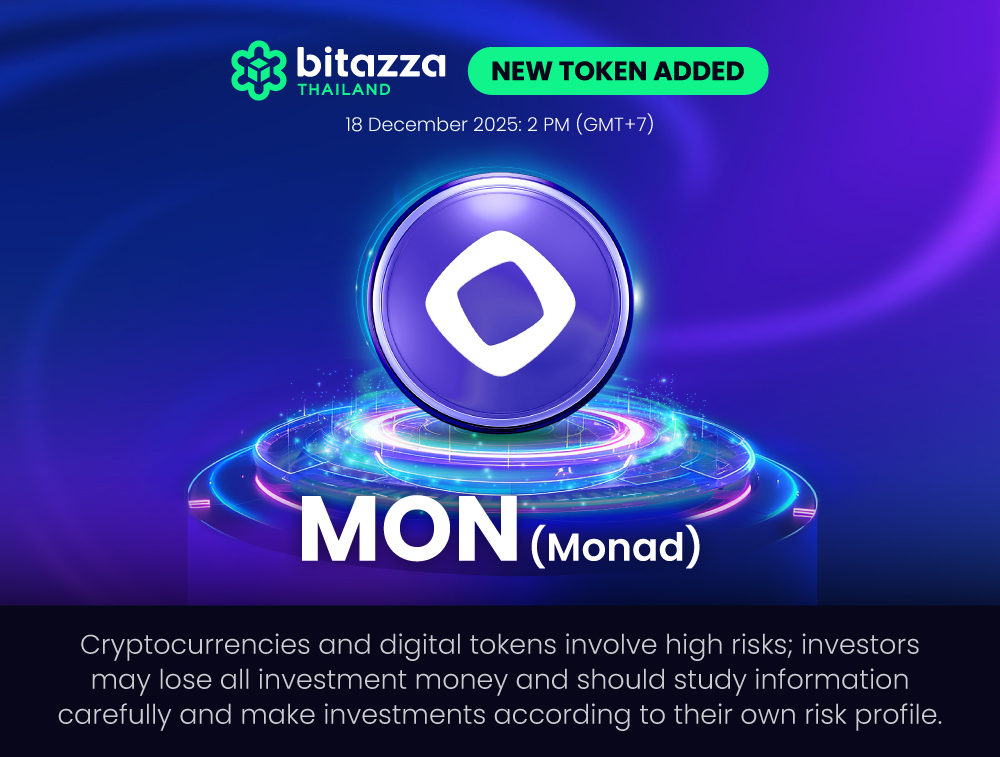
How to Monad (MON) on Bitazza Thailand
You can easily trade MON tokens on Bitazza Thailand starting 18 December 2025 at 14:00 (GMT+7). Simply log in, deposit Thai Baht (THB), and search for the MON/THB trading pair from over 120+ available crypto pairs. You can now add MON to your portfolio and become part of the protocol. (Information as of December 2025)
What is Monad (MON)?
Monad (MON) is a high-performance, EVM-compatible Layer 1 blockchain designed to push Ethereum-style smart contracts to 10,000+ transactions per second while keeping decentralization and security. It achieves this with sub-second finality (around 400 ms block times and ~800 ms finality) and full bytecode compatibility with the Ethereum Virtual Machine.
Developers can redeploy existing Ethereum dApps on Monad without rewriting contracts, and users can interact with Monad through familiar tooling and RPC standards from the Ethereum ecosystem.
Monad is developed by Monad Labs, founded in 2022 by Keone Hon, James Hunsaker, and Eunice Giarta, all former Jump Trading engineers. The project has raised about $225M in funding, including a major Series A led by Paradigm, positioning Monad as one of the most heavily backed next-gen L1s in the market.
MON is the native token that powers Monad: it is used for transaction fees and staking to secure the network. At the launch of Monad Public Mainnet on 24 November 2025, the total initial supply of MON was fixed at 100 billion tokens.
Purpose of Monad (MON)
Monad was created to solve core bottlenecks in general-purpose blockchains, especially Ethereum: limited throughput, high fees under load, and difficulty scaling without sacrificing decentralization.
Its mission is to:
- Deliver a high-throughput, decentralized L1 that can support consumer-scale applications (10,000 TPS, sub-second finality)
- Preserve full EVM and Ethereum RPC compatibility so existing apps, tools, and wallets can migrate easily
- Use a modern architecture (parallel and deferred execution, pipelined consensus, optimized storage) to remove the perceived trade-off between performance and decentralization
By doing this, Monad aims to be an execution layer where DeFi, gaming, social, and infrastructure projects can scale without leaving the Ethereum developer ecosystem behind.
Why Choose Monad (MON)?
High throughput, low latency
Monad targets ~10,000 TPS with ~400 ms block times and ~800 ms finality using parallel execution and pipelined consensus, significantly increasing capacity versus Ethereum while keeping the user experience near-instant.
Ethereum-native experience
Full EVM bytecode and Ethereum RPC compatibility means Solidity contracts, dev tools (e.g., Hardhat, Foundry), wallets, and analytics built for Ethereum can work on Monad with minimal changes, reducing migration friction and onboarding time.
Modern architecture and aligned token design
MonadBFT consensus, deferred and parallel execution, and MonadDB storage are engineered to scale performance at the software level while supporting a globally distributed validator set. MON is used for gas, staking, and ecosystem incentives, with a fixed 100B total supply and multi-year lockups and vesting for team and investor allocations—leaving a large portion reserved for ecosystem growth and network incentives.
How Does Monad (MON) Work?
Monad runs as a proof-of-stake, EVM-compatible Layer 1 where validators stake MON to participate in consensus and earn block rewards and fees.
Its architecture separates ordering from execution:
- Consensus (MonadBFT) orders transactions into blocks using a pipelined BFT protocol.
- Deferred & parallel execution then processes those ordered transactions in parallel, using optimistic execution and conflict detection to ensure deterministic results without sacrificing throughput.
- MonadDB stores and updates state efficiently so nodes can keep up with high transaction volumes without specialized hardware.
Because Monad keeps full EVM and Ethereum RPC compatibility, dApps, wallets, and infrastructure from Ethereum can plug into this architecture and immediately benefit from the higher performance and lower fees.
Monad (MON) Basics
- Blockchain: Monad Layer 1 (EVM-compatible)
- Total Supply: 100,000,000,000 MON
- Circulating Supply: 10,830,583,396 MON (As of 16 December 2025)
- Primary Uses: Transaction fees, staking to secure the network, and ecosystem incentives (grants, liquidity, and growth programs) across the Monad DeFi and dApp ecosystem
Reference
CoinMarketCapDisclaimers
*Cryptocurrency and digital tokens involve high risks; investors may lose all investment money and should study information carefully and make investments according to their own risk profile.
**Past performance does not guarantee future performance.
Share this
Subscribe by email
พบกับ Mantle (MNT) สะพานเชื่อมการเงินดั้งเดิมเข้ากับยุคใหม่บน Ethereum
พบกับ Monad (MON) สาย DeFi ที่มุ่งปิดข้อจำกัดการขยายตัวของ Ethereum

พบกับ MemeCore (M) บล็อกเชนเลเยอร์ 1 ตัวขับเคลื่อนยุค Meme 2.0

พบกับ Spark (SPK) ตัวจัดสรรเงินทุนบนเชน ผู้อยู่เบื้องหลัง DeFi, CeFi และ RWA
พบกับ Kite (KITE) โทเคนเพื่อ AI Agent อิสระ

พบกับ Morpho (MORPHO) DeFi ด้านการปล่อยกู้ที่ตอบโจทย์ทั้งฝ่ายให้กู้และฝ่ายกู้
พบกับ Ether.fi (ETHFI) ทางเลือกใหม่ของการสเตก ETH ที่ยังเอาไปใช้ต่อได้
พบกับ Plasma (XPL) บล็อกเชนเลเยอร์ 1 ที่เน้นการชำระเงินด้วย Stablecoin

สหรัฐฯ เตรียมยกระดับแผนส่งเสริมคริปโตต้นปี 2569